

The best RFP tool is the one that fits the work you actually need to deliver: a persuasive proposal, a completed questionnaire, a traceable compliance matrix, or a coordinated response from a large team. This 2026 comparison covers 31 product entries, their workflows, current public pricing where available, and how to evaluate them.
For small suppliers, independent consultants, and lean teams responding to opportunities they already have, DeepRFP is our pick for a structured AI proposal workspace. It brings opportunity files, company material, analysis, drafting, questionnaires, and reviews into one place. Teams needing opportunity discovery, extensive enterprise approvals, or specialized document control should also consider the relevant categories below.
Disclosure: Published by DeepRFP, which we feature first. Some placements reflect reciprocal arrangements; the order is not an independent performance ranking.
The count is 31 product entries, rather than 31 independent companies. It includes acquired and related brands, including Rogue and RFP360. ChatGPT, Claude, and Gemini appear separately as general-purpose alternatives. Categories indicate a buying use case; several products span more than one.
Jump to:
Best-fit by use case · AI RFP software top pick · Vendor breakdown · AI RFP explainer video · Automation basics · Common questions · Methodology
Best RFP tools by use case:
Start with the bottleneck in your response process. Narrative drafting, recurring sales questionnaires, government opportunity discovery, and enterprise coordination require different workflows. A DDQ is a due diligence questionnaire; RFP shredding means breaking a solicitation into requirements, instructions, and evaluation criteria you can track.
| Use case | Best-fit tools |
|---|---|
| AI RFP software for narrative proposals, small businesses, consultants, and lean teams | DeepRFP, plus ChatGPT/Claude/Gemini as DIY chatbot alternatives |
| Government RFP software and B2G revenue platforms | Civio, GovSignals, Procurement Sciences |
| Public tender discovery and bid response software | Sweetspot, Tendium |
| AI proposal generator software for narrative proposal drafts for enterprise teams | Bidara, AutogenAI, Rohirrim |
| RFP response automation software for recurring questionnaires and sales teams | AutoRFP.ai, Inventive AI, BidScript, Fastbreak, Thalamus AI |
| Security questionnaire, DDQ, and compliance answer automation | 1up, Arphie, Conveyor, Vendict, Iris |
| Enterprise RFP management software and response platforms | Responsive, Loopio, Upland Qvidian, RFP360, Altura |
| Federal proposal compliance, RFP shredding, and proposal review tools | Meridian Series, 123PAS, VisibleThread, Rogue |
| Proposal document automation and Microsoft 365 proposal tools | QorusDocs, Expedience Software, XaitPorter |
Use this table to find a relevant category, then check the detailed entry for pricing, evaluation access, and practical limits.
AI RFP software for narrative proposals, small businesses, consultants, and lean teams
DeepRFP — AI RFP Software for Narrative Proposals and Lean Teams (Top pick)
DeepRFP AI RFP Software is built for suppliers who have an RFP or RFQ in hand and need help turning their own company evidence into a response. It is a self-service proposal workspace, with specialized AI workflows for analysis, writing, questionnaires, matrices, and review.
DeepRFP gives owners, salespeople, consultants, and small proposal teams a defined place to develop each response. Keep the solicitation and relevant company files together, use the company library and past proposals as context, and develop outputs through a repeatable analysis → draft → review process. You can also ask questions about the opportunity while working.
AI RFP workspace and proposal workflows
- Understand the opportunity: analyze instructions, requirements, risks, and bid/no-bid considerations before committing to a response.
- Build the response: develop narrative drafts or questionnaire answers from the opportunity and the material you provide.
- Check and refine: create compliance matrices and review drafts for gaps, clarity, and alignment. You remain responsible for validating requirements and approving the submission.
Choose it when you want these proposal tasks in a dedicated workflow without designing your own sequence of chatbot prompts. It does not provide a live opportunity-discovery database or a managed bid-writing service. If those are your main need, start with the government or tender-discovery categories.
For a practical fit check, read DeepRFP reviews, pricing, and evaluation.
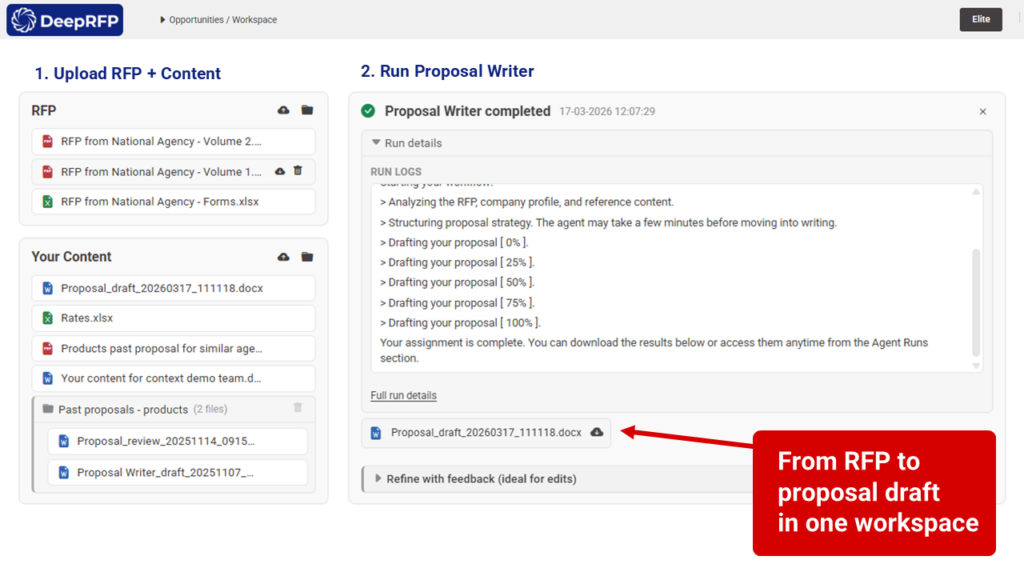
AI RFP tools and outputs
- Narrative proposals: use the AI proposal generator to create a structured first draft for review and tailoring.
- RFP and RFQ responses: explore the AI RFP response generator and RFQ software for responses grounded in your supplied material.
- Questionnaires: prepare answers for recurring questions and Excel forms, then verify the claims and the exported file.
- Requirements: use RFP shredding and compliance matrix software to structure requirements into reviewable reports.
- Decision support and review: analyze the opportunity, review proposal content, and use Elite’s pricing guidance to inform your own commercial decision.
Provide current capability statements, relevant past performance, approved answers, and a clear brief. AI cannot establish a certification, delivery commitment, or price that your business has not validated. Test the actual file types, tables, scanned pages, and output formats you use during evaluation.
Start the seven-day DeepRFP trial; no credit card required.
Sources: Product and evaluation · Plans and trial
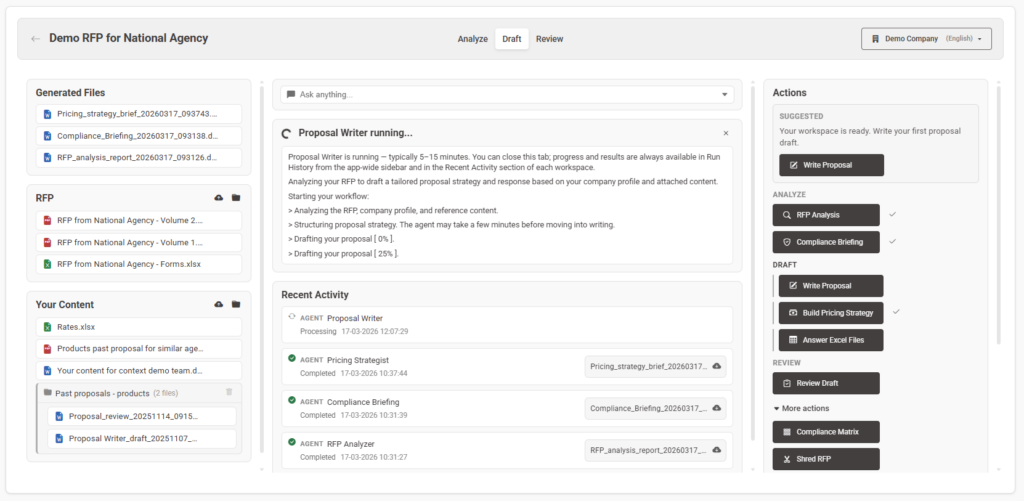
Pricing
DeepRFP Pro is US$89 per user per month on monthly billing; Elite is US$149 per user per month. Pro includes the proposal workspace, company library, analysis, writing, reviews, Excel forms, and compliance matrices. Elite adds pricing strategy, compliance briefings, custom instructions and styles, custom matrices, and multiple company profiles. The annual option is paid upfront for 12 months at the price of 10. Compare the current DeepRFP plans before subscribing.
Both plans advertise unlimited usage. Monthly subscriptions can be canceled; annual billing is paid upfront. Check the refund terms before choosing the annual option.
Free trial
You can try DeepRFP for seven days with full features and no credit card. It does not automatically charge you when the trial ends. Use it to complete a representative opportunity from analysis through an exported draft or questionnaire, rather than judging only a sample paragraph.
Data privacy and storage
DeepRFP does not use your uploads, inputs, or generated content to train AI models. Its AI providers do not train their models on this data either.
Here is how the app handles your business data:
- AI processing: tool and agent inputs and outputs are processed in the US through Microsoft Azure OpenAI or the OpenAI API. DeepRFP may switch providers for technical reasons; users cannot select or check which provider is used for a run.
- Account and workspace records: company profiles, settings, workspace records, and workspace-linked runs are stored with DigitalOcean in New York City. Profiles, settings, and workspace records remain until you delete them or the account is terminated; manually deleted information can remain in backups for up to 30 days. Workspace-linked conversations, runs, generated outputs, and metadata remain while the workspace exists. After you delete a workspace, related run data is purged following a 30-day backup window, on a daily schedule.
- Library files: uploaded files and output files are stored with AWS in Northern Virginia. They remain until you delete them, the account is terminated, or expired-trial cleanup removes them. Manually deleted files are purged after a 30-day backup window.
- Standalone runs: legacy tool and agent run records that are not linked to a workspace are automatically deleted after 30 days, with no backups retained beyond that period. Library files follow the separate rule above.
- Access and abuse monitoring: stored app data is accessible to you and DeepRFP administrators. For account/workspace data and Library files, administrator access is limited to requests or technical necessity. DeepRFP and its AI providers retain tool and agent inputs and outputs for abuse monitoring for up to 30 days, with review only when automatic flags indicate potential abuse. This data is then permanently deleted unless retention is required by law. Abuse-monitoring retention is separate from workspace and Library storage.
These rules are set out in section 1.3.2 of the DeepRFP app terms. Match this stated US processing, storage, access, and deletion arrangement to the requirements of the files you plan to upload.
Who DeepRFP is for
Choose DeepRFP if you already have the opportunity, have company evidence to work from, and want structured support for drafting and review. The monthly per-user model and no-card trial make the purchase easy to evaluate for a solo supplier or small team. For a large rollout, first confirm the approval controls, permissions, integrations, and document-management requirements you need; an enterprise response platform may be a better fit.
DeepRFP reviews and user feedback
You can read the DeepRFP reviews on Capterra alongside the DeepRFP evaluation guide. Look for reviewers with a similar workflow and use the trial to assess the tasks that matter to your business.
Takeaway
Our pick for small suppliers and lean teams that want a structured proposal workspace. DeepRFP helps you move from opportunity files and company evidence to drafts, answers, matrices, and reviews. Your team still owns factual accuracy, compliance, pricing, and final submission.
Sources: Pricing and trial · Fit and evaluation · App data handling and terms · Personal-data privacy policy
General AI chatbots: ChatGPT, Claude, and Gemini
General-purpose assistants can be useful for summarizing an RFP, exploring an outline, rewriting a paragraph, or asking questions about supplied documents. Their file and project features mean the choice is broader than copying isolated text into a blank chat: ChatGPT supports work with attached files, Claude Projects use a shared knowledge base, and Gemini can analyze uploaded documents and spreadsheets. Availability and limits depend on the product, plan, account, and settings.
A capable user can build a proposal process around these tools. The practical question is how much process you want to design and maintain: selecting the right evidence, tracking requirements and versions, prompting consistently, reviewing answers, and getting the result into the buyer’s required format. Choose between a flexible assistant and a dedicated workspace according to the response process you want to run.
Who should choose this route? Someone doing occasional drafting or analysis who already has a workable system for files, requirements, and review. A dedicated proposal workspace is worth evaluating when you repeat the same response tasks and want that structure supplied by the product. Compare current plan limits and the privacy terms of the exact account you would use before uploading confidential material.
Takeaway: Chatbots are a credible flexible alternative. Test the complete response process and the review effort, rather than comparing one impressive answer with a finished proposal workflow.
Sources: ChatGPT documentation · Claude Projects · Gemini file analysis
For a deeper explanation of this distinction, watch our video on AI RFP software, chatbots, AI agents, and enterprise RFP tools.
Best AI RFP Software in 2026: ChatGPT vs AI Agents vs Enterprise RFP Tools →
The main point is that there is no single “best RFP tool” for everyone: a chatbot, an AI RFP workflow tool, and an enterprise response management platform can all be the right choice depending on the buyer, the proposal process, and the type of RFP. In the video, we explain where DeepRFP fits, when a DIY chatbot approach may be enough, and when a larger enterprise platform may make more sense.
For our recommended fit, return to the DeepRFP entry or use the DeepRFP reviews, pricing, and evaluation guide to plan your trial.
Government RFP software and B2G revenue platforms
Civio – Government RFP / B2G Revenue Platform Overview
Civio is a government-contracting and business-to-government platform for companies pursuing public-sector revenue. It connects qualification, capture, proposal writing, and pursuit execution.
AI approach and workflow
The vendor describes governed AI teammates that use company knowledge to assess opportunities, analyze RFX requirements, prepare compliance matrices and drafts, and help coordinate the pursuit. Human permissions and approvals are part of that operating model. This makes it relevant when the problem is coordinating a government pipeline and proposal work together.
Pricing and evaluation
Contact Civio for pricing. It offers a demo and a Value Sprint evaluation; confirm the sprint’s scope, cost, and any ongoing commitment.
Who it suits and what to check
Consider Civio if you need an integrated B2G process. Ask it to demonstrate an opportunity moving through qualification, capture tasks, drafting, and review with your roles and approval gates. If you only need occasional proposal drafting, evaluate whether that broader operating model earns its place in your process.
Takeaway: Consider Civio for qualification, capture, and proposals in one government-revenue workflow.
Sources: Official FAQ.
GovSignals — Government RFP Tool Overview
GovSignals serves both government buyers and industry. For this supplier-side comparison, the relevant offering is its industry workflow for finding opportunities, assessing fit, managing capture, and developing proposals; its procurement offering is a different buying context.
AI approach and workflow
The industry platform connects signals and opportunity information with CRM-style pursuit work, playbooks, bid/no-bid support, and proposal generation. The vendor also describes a deployment strategist alongside its AI agents, which is an important difference from a purely self-service writing tool.
Pricing and evaluation
The pricing page describes a flat annual engagement based on size and complexity, rather than per-seat pricing, with the platform, agent roster, and deployment strategist included. Contact GovSignals for the price and terms of its proof-of-value evaluation, including the industry deployment covered.
Who it suits and what to check
Consider it when government pipeline intelligence, capture coordination, and proposal execution belong in the same operating process. Show the vendor how your team works and ask which integrations, deployment arrangements, and review controls the quote covers. Include deployment support and the wider pursuit workflow when comparing its annual cost.
Takeaway: A broader government-pursuit offering whose annual engagement and deployment scope matter as much as draft generation.
Sources: Industry and product overview · Pricing.
Procurement Sciences (Awarded.ai) — Government RFP Tool Overview
Procurement Sciences presents Awarded AI as part of its GovCon platform. It combines business development, capture, intelligence, and proposal support for contractors who want to connect the wider pursuit lifecycle.
AI approach and workflow
Its proposal workflow uses company information such as past performance and resumes for AI-assisted writing, alongside capture and business-development work. The platform also lists HigherGov intelligence. These are broader jobs than generating a narrative draft from an already selected RFP.
Pricing and evaluation
Request pricing through a tailored demo. The free AI win-strategy offer is separate; ask about evaluation access to the full platform. Ask for the licensed modules, onboarding, intelligence access, and contract term in the quote.
Who it suits and what to check
Consider it if you want an integrated GovCon platform and need discovery, capture, and proposals to share context. It publishes solutions for small contractors as well as larger organizations, so company size alone is not a reason to rule it in or out. Evaluate the practical scope and cost for your pipeline.
Takeaway: Consider Awarded AI as part of an integrated GovCon platform when discovery, capture, and proposal work need to share context.
Sources: Platform · Pricing and evaluation.
Public tender discovery and bid response software
Sweetspot — Public Tender and Government Bid Software Overview
Sweetspot combines government opportunity discovery, pipeline intelligence, and proposal work. It is worth considering when the team’s bottleneck starts before receiving an RFP: identifying relevant opportunities and deciding which to pursue.
AI approach and workflow
The current site describes federal, state and local opportunities and grants, award intelligence, monitoring agents, and a proposal engine that uses organization content. Requirements extraction, compliance matrices, outlines, drafting, review, and integrations such as SharePoint and Salesforce extend the workflow beyond discovery.
Pricing and evaluation
Sweetspot offers a tailored demo; contact the vendor for pricing and evaluation access. Request a quote that separates discovery coverage, proposal access, users, integrations, and any onboarding.
Who it suits and what to check
Choose it for a connected GovCon discovery-to-response process if its coverage matches your target agencies and markets. Test both halves of that process: whether it finds opportunities you would pursue, and whether the proposal outputs meet the RFP. Opportunity relevance and response quality both matter to this purchase.
Takeaway: A discovery and proposal platform to evaluate on opportunity relevance and response deliverables together.
Sources: Product · Current pricing/demo route.
Tendium — Public Tender Response Software Overview
Tendium combines tender monitoring with bid qualification and response work. Its Find product handles monitoring; BidFlow supports the response process, while Louie provides AI assistance.
AI approach and workflow
The workflow includes tender summaries, qualification, bid writing, and coordination. This is relevant for teams managing public tenders across multiple pursuits. Coverage and intelligence are regional purchasing considerations: the pricing page limits its Intelligence add-on to Sweden, Norway, and Finland.
Pricing and evaluation
Light starts at €125 per month as advertised for tender monitoring. Core adds BidFlow and is quoted according to bid volume; Scale adds controls such as permissions and SSO. The page lists unlimited users and advertises a free trial. The €125 starting amount should not be read as the price of the complete bid-response platform; confirm billing commitment and trial scope.
Who it suits and what to check
Consider Tendium if tender monitoring and bid collaboration are linked needs. Validate the countries, public sources, languages, and add-ons that cover your market before comparing prices. A response team should evaluate Core or Scale’s output and workflow, rather than comparing only Light’s monitoring fee.
Takeaway: A monitoring-plus-bid platform; distinguish the entry monitoring plan from response software and country-specific intelligence.
Sources: Product · Plans and regional limits.
Before there is an RFP: capital-project research
For suppliers of industrial equipment and systems, opportunity research can begin before an RFP is issued. CapexCue helps teams explore capital projects through dated public sources, assess whether the scope fits what they supply, and identify what to investigate next. It supports the earlier pursuit decision; the RFP response tools compared here become relevant when there is a solicitation to answer. A listed project does not necessarily mean procurement is open.
Disclosure: CapexCue and DeepRFP share the founder.
AI proposal generator software for narrative proposal drafts for enterprise teams
AutogenAI — Enterprise AI Proposal Generator Overview
AutogenAI is a bid, proposal, and grant-writing platform using organizational knowledge to develop responses. It offers enterprise, federal, and nonprofit solutions; confirm the solution and commercial scope appropriate to your organization.
AI approach and workflow
The platform covers qualification through submission, with AI-assisted drafting, company content, evidence, and team collaboration. It describes a tailored language engine for each organization. This makes it relevant to substantial narrative responses where company-specific material and review need to stay connected.
Pricing and evaluation
Contact AutogenAI for pricing and a booked demo. Ask for the specific solution, content preparation, onboarding, user access, and commitment in your quote.
Who it suits and what to check
Consider it when writing and coordinating substantial proposals is the core job and you want a configured organizational platform. During evaluation, inspect how a draft follows instructions, references evidence, handles missing information, and moves through review. Evaluate the configuration and commitment for your team rather than using company size as a proxy for quality.
Takeaway: A company-grounded narrative proposal platform to assess on drafting, evidence, and collaboration using the solution suited to your organization.
Sources: Product and solutions · Federal offering.
Bidara — AI Proposal Generator Overview
Bidara is a proposal-generation platform for teams drafting responses from an RFP and their company knowledge. It combines document analysis, draft creation, and an editor for team review.
AI approach and workflow
Its support documentation lists RFP uploads in formats including PDF, Word, PowerPoint, Excel, and text-based files. The workflow analyzes the RFP, creates a draft from the knowledge base, supports collaboration through role permissions, and exports to Word or PDF. Evaluate export fidelity with your own layout and tables.
Pricing and evaluation
Starter is US$299 per month, billed annually, for up to three team members, 10 AI-generated responses per month, and 200 knowledge-base documents. Growth is US$599 per month, billed annually, with up to 10 members, 30 responses per month, and 1,000 documents; Enterprise is custom. The free trial provides five days, no card, and up to one complete proposal. Budget for an annual team-and-volume subscription.
Who it suits and what to check
Consider it when you want a defined proposal drafting and editing workflow with a public team allowance. Compare the response and knowledge-base limits against your workload and confirm renewal/cancellation terms for the annual purchase. Test the quality of the complete export, including the factual checks your team must make.
Takeaway: A narrative-drafting option with explicit team and volume allowances; annual billing and the one-proposal trial limit are material.
Sources: Workflow and formats · Pricing and trial.
Rohirrim (RohanRFP) — Enterprise AI Proposal Generator Overview
Rohirrim currently presents UnifiedRespond for proposals and RFP responses grounded in an organization’s material. Readers researching RohanRFP should check the current product and licensing offered under UnifiedRespond.
AI approach and workflow
UnifiedRespond documents company-content drafting, source-linked knowledge answers, and Shred-to-Comply analysis that maps federal Sections L, M, and C into compliance artifacts and outlines. It also describes a research mode with cited web information. Buyers should distinguish approved company evidence from outside research when reviewing a draft.
Pricing and evaluation
Contact Rohirrim for pricing and a UnifiedRespond demo. Confirm the licensing, deployment, content setup, and any pilot terms.
Who it suits and what to check
Consider it for substantial narrative responses, including federal proposals where requirements mapping matters. It describes single-tenant and flexible deployment options; obtain the precise architecture and data terms applicable to your contract rather than assuming every configuration uses only internal processing. Test traceability from solicitation to draft and evidence.
Takeaway: A narrative and compliance workflow now presented as UnifiedRespond; evaluate the actual deployment and separation of company evidence from research.
Sources: Vendor · UnifiedRespond.
RFP response automation software for recurring questionnaires and sales teams
AutoRFP.ai — RFP Response Automation Software Overview
AutoRFP.ai automates recurring RFP and questionnaire responses using company content. Its current scope also includes narrative proposal documents, giving teams both answer-based and document-based workflows to evaluate.
AI approach and workflow
The product pages describe a Project Agent, source-grounded responses, collaboration, and proposal generation and Word export. The practical comparison is how well it handles your question sets and complete documents, including the review and formatting work needed after generation.
Pricing and evaluation
Scale is US$899 per month, paid annually, for 24 projects per year; Accelerate is US$1,299 per month, paid annually, for 50 projects. The pricing page lists unlimited users and all features on each plan. Its 30-day refund is conditional: import three previous responses, invite two users, create one project, approve five responses, and export one project. The page states a minimum 12-month term after the first 30 days. This is a refund policy attached to a purchase, rather than a no-card free trial.
Who it suits and what to check
Consider it for a team sharing a response workload across many contributors, especially if project-based pricing suits your volume. Clarify what counts as a project and how additional volume is handled. Test narrative generation as well as questionnaires, including source accuracy and the complete exported document.
Takeaway: Consider AutoRFP.ai for shared questionnaires and proposal generation when its annual project allowance fits your team’s workload.
Sources: Proposal generation · Plans and refund conditions.
BidScript — RFP Automation Tool Overview
BidScript supports in-house bid teams through opportunity selection, response development, and learning from completed submissions. Its current site addresses UK mid-market teams and includes BidSearch discovery alongside the response workflow.
AI approach and workflow
The process draws on past submissions, case studies, and company knowledge to qualify and build a bid, then retain learning. Team ownership, tasks, and review sit around the drafting work. That makes it a broader bid process than simply filling recurring questionnaire cells.
Pricing and evaluation
Contact BidScript for pricing and a demo. Ask which discovery, knowledge, drafting, and collaboration features are included, along with volume allowances, onboarding, billing period, and any trial access.
Who it suits and what to check
Consider BidScript if you want discovery and response work in a repeatable process for an internal bid team. Check opportunity coverage for your market and demonstrate how your approved evidence reaches the draft. Evaluate discovery and narrative drafting alongside its questionnaire workflow.
Takeaway: A connected bid-team workflow with discovery and reusable company knowledge; request the commercial scope before comparing costs.
Sources: Product and demo route.
Fastbreak — RFP Response Automation Tool Overview
Fastbreak is an RFP response brand associated with Vendorful. Its public brand page links to vendorful.ai, but current Fastbreak availability is unconfirmed.
AI approach and workflow
Vendorful’s accessible official response-management page describes AI-assisted RFP answers built from previous responses and marketing material, with a knowledge repository and collaboration. Ask Vendorful which of those capabilities are available in the response product it currently offers.
Pricing and evaluation
Contact Vendorful for current pricing, the relationship to Fastbreak, and evaluation access. Confirm the product and contract terms before relying on historical Fastbreak offers.
Who it suits and what to check
Keep it on a shortlist only if the vendor can demonstrate the response product you would actually buy. Check import, evidence references, collaboration, and export in that current product.
Takeaway: Confirm the current Vendorful offer and its connection to Fastbreak before shortlisting it.
Sources: Vendor-owned Fastbreak identity · Vendorful response workflow.
Inventive AI — RFP Response Automation Platform Overview
Inventive AI uses a connected company knowledge hub and AI agents for RFPs and security questionnaires. It is relevant when responses draw on information spread across several business systems.
AI approach and workflow
Its site describes integrations such as SharePoint, Google Drive, and Notion, source-cited drafts, team assignments, and content-management agents that flag outdated or conflicting answers. Research and response workflows share the knowledge base. The useful test is whether the right evidence is found and kept current for your review process.
Pricing and evaluation
Pricing starts at US$10,000 per year. The pricing model includes a fixed platform fee plus usage per RFP or security questionnaire, with unlimited users and all features listed. It also describes unused RFP rollover. Include response allowances and rollover rules in your annual budget; unlimited users does not mean unlimited projects. The current route is a demo.
Who it suits and what to check
Consider it for a team with repeated responses and distributed source material. Test permission handling, conflicting evidence, citations, and update ownership across the connectors you need. Compare projected annual usage alongside the platform fee.
Takeaway: A connected knowledge-and-response platform; budget for platform plus response usage, and test content freshness as well as draft speed.
Sources: Product · Pricing model.
Thalamus AI — Agentic RFP Automation Tool Overview
Thalamus AI presents a bid-lifecycle platform that covers qualification, drafting, compliance, and team review. Its current scope includes long narrative responses, RFIs, RFQs, DDQs, and portal responses as well as questionnaires.
AI approach and workflow
The site describes bid scoring, requirement extraction, compliance matrices, clarification registers, and addendum handling. Roles, versioned reviews, and approval gates connect subject-matter experts with the response process, supported by an organizational knowledge graph.
Pricing and evaluation
Pricing is configured around RFx volume, team size, workflows, and integrations. Contact Thalamus AI for pricing and a demo. Request the licensed workflows, volume, onboarding, integrations, and term.
Who it suits and what to check
Consider it for teams that need coordination and compliance tracking across complex bids. During evaluation, introduce an addendum and see whether affected requirements and drafts remain traceable through review. For regulated work, distinguish certification of hosting infrastructure from certification of the vendor and the deployment you would use.
Takeaway: A broad response-and-review workflow to evaluate on requirements traceability, changes, and team controls.
Sources: Product · Pricing approach.
Security questionnaire, DDQ, and compliance answer automation
Arphie — RFP Questionnaire and Security Questionnaire Overview
Arphie uses AI agents and connected knowledge to support RFPs, due diligence, and security questionnaires. Its drafting capabilities also include narrative first drafts for teams that handle both questionnaires and written proposals.
AI approach and workflow
The platform connects sources including Google Drive, SharePoint, Confluence, Notion, Seismic, and Highspot. It describes source references, confidence information, content maintenance, and collaboration with subject-matter experts. Those features are useful when answers need to be grounded in current product and policy material rather than remembered by one salesperson.
Pricing and evaluation
Contact Arphie for pricing and evaluation access. Confirm the included connectors, user and response allowances, onboarding, billing commitment, and practical trial access before budgeting.
Who it suits and what to check
Consider it when distributed knowledge and reviewable answers are central to your sales process. Test conflicting sources, permission boundaries, evidence links, and the path from an AI draft to an approved answer. Confidence indicators can help prioritize review, but do not prove that an answer is correct.
Takeaway: A connected knowledge and response platform; evaluate evidence quality and review effort on your actual questionnaires and narrative documents.
Sources: Product and evaluation.
Conveyor — Security Questionnaire Automation Overview
Conveyor combines a customer trust center with AI-assisted security questionnaires and RFP responses. Its scope is especially relevant to companies whose sales cycles involve security evidence, buyer portals, and repeated technical questions.
AI approach and workflow
Its product and pricing pages document questionnaire automation, browser and document workflows, and review around company knowledge. The trust center lets buyers access approved material; the response workflow handles questions that still need answers. Test the exact portals, Word files, and questionnaires used by your customers.
Pricing and evaluation
Full-platform pricing is custom and usage-based, with unlimited seats. The free Trust Center plan is not a free questionnaire-automation plan: it lists 10 credits per month and 15 documents or Q&As, but excludes questionnaire automation and integrations. Conveyor separately advertises an AI trial involving supplied example content and a kickoff. Confirm the trial’s duration and included workflows before scheduling the evaluation.
Who it suits and what to check
Consider it when customer trust and security responses are part of the same selling process. Inspect evidence access, reviewer handoffs, and portal export or completion. Compare the response service you need rather than using the free trust-center allowance as the cost of automation.
Takeaway: A trust-and-response option with distinct free and paid scope; evaluate the questionnaire workflow separately from the trust center.
Sources: Product · Pricing, free scope, and trial.
Iris — RFP and Security Questionnaire Automation Overview
Iris supports pursuit decisions, research, response writing, and collaboration, including RFPs, proposals, DDQs, and security questionnaires. Its scope connects opportunity work with both narrative and answer-based responses.
AI approach and workflow
The site presents Go/No-Go, Research, War Room, Respond, Collaborate, and Insights workflows. Approved source material supports responses, with team coordination around the writing. Evaluate how those workflows connect opportunity context to an answer or narrative draft and its review.
Pricing and evaluation
The pricing page describes a per-active-user model with unlimited usage across RFPs, proposals, DDQs, and security questionnaires. Contact Iris for pricing and a demo. Confirm what counts as an active user, the licensed modules, billing interval, integrations, and any minimum commitment.
Who it suits and what to check
Consider Iris if sales and proposal teams want shared pursuit context as well as response drafting. Ask it to demonstrate both a recurring technical questionnaire and a narrative proposal, including evidence validation and approval. Budget for the users who would actively participate.
Takeaway: A pursuit-and-response platform with per-active-user pricing; check the full workflow and commercial definition of an active user.
Sources: Workflows · Pricing approach.
Vendict — DDQ and Compliance Questionnaire Automation Overview
Vendict covers both supplier-side questionnaire responses and buyer-side third-party risk management. The response platform is the relevant product here; a vendor-risk trial is not automatically access to that same workflow.
AI approach and workflow
Its Questionnaire Response Automation uses a file-based knowledge base, source-backed answers, configurable response styles, and review/approval workflows. The platform also offers an interactive trust center and RFP/RFI automation. This is useful when sales and security teams must keep responses aligned with current evidence.
Pricing and evaluation
The response pricing page lists Growing with five questionnaires per month and one library, Scaling with 15 questionnaires and three libraries, and Enterprise with 25-plus questionnaires and five-plus libraries. All list unlimited seats, but prices require contact. Connectors and role/library access appear in Scaling; SSO and custom integrations appear in Enterprise. The advertised 14-day trial concerns third-party ecosystem risk, so confirm evaluation access for questionnaire responses separately.
Who it suits and what to check
Consider it when evidence-backed security answers, approval, and buyer trust need to work together. Match your questionnaire volume, product libraries, connector requirements, and access controls to the right tier. Do not treat features listed in a higher tier as part of every quote.
Takeaway: A security and response platform with clear tier allowances; separate supplier responses from buyer risk-management offers.
Sources: Product · Response tiers and trial scope.
1up — Security Questionnaire and RFP Answer Automation Overview
1up is a knowledge and answer-automation product for sales, RFPs, and security questionnaires. Its workflows include answering from company content, working with document questionnaires and portals, and making answers accessible to sales teams.
AI approach and workflow
The platform supports response work in formats such as Excel, Word, and PDF, along with browser-based completion and knowledge access. The practical value is a consistent answer workflow where sales and subject-matter experts can draw on the same source material.
Pricing and evaluation
On the pricing page’s monthly Employee Answers view, Starter is US$300 per month for one questionnaire; Plus is US$900 per month for six questionnaires. Those tiers list unlimited users and answers, but questionnaires have their own allowance. A free plan lists one admin and 50 answers per month. The US$50-per-month MCP offering adds US$0.05 per question for questionnaire automation through an AI-tool connection; it is a separate access model, not the full Starter plan for $50. A trial is advertised; confirm its scope and current billing options.
Who it suits and what to check
Consider it for repeated sales answers and questionnaire work. Estimate questionnaire volume, check what counts toward the allowance, and test portal completion and exported files. Compare the full platform and the MCP connection according to how your team would use them.
Takeaway: An answer-automation option with public monthly allowances; distinguish answers, questionnaires, and the separate MCP offering.
Sources: Product · Plans and allowances.
Enterprise RFP management software and response platforms
Altura — Enterprise Bid Management and RFP Software Overview
Altura is a bid-management platform for coordinating tenders and proposals across a team. It connects requirements, company knowledge, and review work in a shared bid process.
AI approach and workflow
The official site describes a BidBook with source-linked requirements, tender and risk analysis, compliance checks, clarification handling, and updates when the tender changes. Configurable workflows and approvals are relevant when different contributors own sections and decisions.
Pricing and evaluation
Contact Altura for pricing and a demo. Request the user scope, workflows, integrations, implementation work, and commitment in your quote.
Who it suits and what to check
Consider it when the work is coordinating a bid rather than only creating a draft. Ask it to demonstrate a changed requirement flowing into assigned work and review, with a clear link back to the source. Validate the markets and languages your team needs and the governance controls included in the proposed package.
Takeaway: A collaborative bid-process platform to assess on requirements, ownership, changes, and approvals.
Sources: Official product.
Loopio — Enterprise RFP Response Platform Overview
Loopio is a response-management platform centered on a reusable content library, AI-assisted answers, and project collaboration. It is relevant to teams running many responses with several reviewers and content owners.
AI approach and workflow
The pricing page lists generative AI, unlimited projects, and a library in Foundations. Enhanced adds capabilities such as multi-step reviews, confidential projects, and multilingual support; Enterprise addresses separate business units and sandbox environments. These controls are useful differentiators for a governed response operation.
Pricing and evaluation
Pricing is by quote. Foundations and Enhanced each list 10 seats; Enterprise is custom. Translation, some integrations, and onboarding packages are listed as add-ons. Confirm the seats, governance tier, connectors, services, and billing commitment in your quote.
Who it suits and what to check
Consider Loopio when a maintained answer library and repeatable review process are core requirements. Evaluate content ownership, stale answers, permissions, and handoffs with your real reviewers. Match the governance tier and add-ons to your required controls before comparing costs.
Takeaway: Consider Loopio for a maintained answer library and repeatable reviews, with the governance tier your team needs.
Sources: Product · Tiers, seats, and add-ons.
Responsive (formerly RFPIO) — Enterprise RFP Management Software Overview
Responsive, formerly RFPIO, is an enterprise response-management platform for RFPs, proposals, DDQs, and security questionnaires. Its scope includes organizational knowledge, AI workflows, and coordination across a response team.
AI approach and workflow
The current site describes AI agents and digital specialists alongside content management, review, permissions, and integrations. Evaluate how these capabilities work together in a shared response operation, from retrieving approved content to coordinating the final review.
Pricing and evaluation
Pricing combines an annual platform fee, user licenses, and applicable add-ons or services. The pricing page describes unlimited projects and responses. Contact Responsive for a scoped price. Request a demo and a quote covering the AI capabilities, roles, integrations, governance, and services you need.
Who it suits and what to check
Consider Responsive when response management crosses departments or business units and content governance is important. Test how permissions, reviews, and source updates work with your organization. Compare the licensed package and annual total with the response work and governance your organization needs.
Takeaway: Consider Responsive for response work across departments, with AI workflows and governance scoped in one annual package.
Sources: Platform and AI · Pricing model.
RFP360 (Responsive RFP360) — RFP Management Software Overview
RFP360 belongs to Responsive, following the RFPIO acquisition. Its request-management workflow serves buyers issuing RFPs and evaluating suppliers.
AI approach and workflow
Responsive’s RFP360 customer material describes creating and issuing requests, collecting vendor responses, maintaining supplier profiles, shortlisting, and evaluation. This is buyer-side sourcing and request management. Suppliers can participate in responses; confirm which AI capabilities are included in the request-management license.
Pricing and evaluation
The current standalone RFP360 offer and trial terms are unconfirmed. Ask Responsive which request-management product is currently offered, how the RFP360 name maps to it, and what your buyer and supplier users would receive.
Who it suits and what to check
Consider this entry if you issue RFPs or manage a sourcing process, rather than primarily write proposals as a supplier. Require a demonstration of the current product and the procurement workflow you need. Focus the evaluation on issuing requests, comparing suppliers, and making sourcing decisions.
Takeaway: An option for buyers issuing and evaluating requests; confirm the current Responsive request-management offer and licensing.
Sources: Acquisition · Owner’s request-management example.
Upland Qvidian — Enterprise RFP Management Software Overview
Upland Qvidian supports proposal and RFP response automation through a content repository, document assembly, and team workflow. It is relevant when approved content and branded proposal production are central to the response process.
AI approach and workflow
The current product page describes AI-assisted content generation and revision, document parsing, reusable content, branded templates, and collaboration with permissions and audit tracking. Word and PowerPoint workflows matter for teams whose deliverable is a formatted business document, rather than only a completed answer grid.
Pricing and evaluation
Contact Upland for Qvidian pricing and a demo. Confirm which AI capabilities, document integrations, governance, onboarding, and services are included in the license and contract term.
Who it suits and what to check
Consider Qvidian for a team producing repeated branded proposals from approved material. Test template assembly, source updates, permissions, and a complete exported document. Ask about the operational work of maintaining the library and templates, as well as the writing assistance.
Takeaway: A content-and-document response platform; evaluate AI assistance alongside assembly, governance, and final document quality.
Sources: Qvidian product.
Federal proposal compliance, RFP shredding, and proposal review tools
Meridian Series — RFP Shredding Software Overview
Meridian Series specializes in solicitation analysis and the compliance artifacts used by proposal teams. Its current site also promotes Meridian AI; evaluate that offering alongside the established requirements workflow.
AI approach and workflow
The toolset includes RFP shredding, compliance matrices, annotated outlines, writer worksheets, storyboards, and proposal coordination. These artifacts connect solicitation instructions and evaluation criteria to assigned writing and review.
Pricing and evaluation
Contact Meridian for software pricing and a demo. Its free Starter Matrix service is separate from a full-software trial. Confirm the modules, licenses, deployment, and evaluation access.
Who it suits and what to check
Consider Meridian for federal proposal teams that need structured requirements and author instructions. Ask it to process an RFP with Sections L and M, amendments, and cross-references, then inspect the matrix and outline. Evaluate its AI assistance alongside the requirements and content workflow.
Takeaway: A requirements-and-compliance specialist; assess the current modules and verify artifacts against the solicitation.
Sources: Product and evaluation.
Rogue (acquired by Procurement Sciences) — GovCon Proposal Writing and Compliance Tool Overview
Procurement Sciences acquired Rogue AI in February 2026. Readers researching the Rogue brand should evaluate how its capabilities are now offered within the acquiring company’s GovCon platform.
AI approach and workflow
The acquisition announcement describes Rogue’s proposal writing and compliance capabilities as part of Procurement Sciences’ broader end-to-end government growth platform. Ask how those capabilities are integrated into the current platform and which workflows are available today.
Pricing and evaluation
Current standalone Rogue plans are unconfirmed. Contact Procurement Sciences for pricing, the modules now offered, evaluation access, deployment, and any migration requirements.
Who it suits and what to check
This is relevant to existing Rogue users and contractors who want to understand how its capabilities fit the wider platform. Ask which workflows are available now, which are on a roadmap, and how existing content and contracts are handled.
Takeaway: Relevant to existing Rogue users and contractors considering Procurement Sciences; assess the current offer and integration.
Sources: Company-issued acquisition announcement.
VisibleThread — Proposal Compliance and Review Tool Overview
VisibleThread combines proposal analysis and review with newer generative AI capabilities. It is useful for teams that want systematic checks alongside drafting, rather than treating language review and content generation as mutually exclusive jobs.
AI approach and workflow
Its capabilities include requirement extraction, compliance matrices, version comparisons, terminology and readability checks, and the Visi assistant. Visi supports grounded answers and drafting using content collections, source references, and a prompt library, extending the platform into content generation as well as analysis.
Pricing and evaluation
The pricing page describes annual per-user subscriptions with unlimited content analysis; contact VisibleThread for a scoped price. Setup and training can be additional. The vendor advertises a free trial with no credit card; confirm the modules, access, duration, and deployment supplied for evaluation. Private and air-gapped options are documented, but their exact availability and scope need to match your purchase.
Who it suits and what to check
Consider it when requirements analysis, document comparisons, and language consistency are important review tasks. Test both deterministic checks and AI outputs, including source references and false positives. For restricted work, specify the deployment and enabled AI workflow you would use.
Takeaway: A proposal analysis-and-review platform with current generative features and an advertised no-card trial.
Sources: Current platform · Pricing · Trial.
123PAS — Federal Proposal Compliance Software Overview
123PAS is a proposal-automation toolkit built around Microsoft Word and Excel. Its public product material focuses on repeatable federal proposal tasks and document mechanics.
AI approach and workflow
The site describes VBA-based tools for compliance matrices, annotated outlines, author assignments, keyword checks, acronym definitions, editing, color reviews, and publishing. That is a rule-based automation workflow to evaluate on the artifacts it creates, rather than a claim that generative AI is required for every useful proposal task.
Pricing and evaluation
Contact 123PAS for current pricing, license terms, and software evaluation access. A free webinar is advertised; it is not a free software trial. Request current licensing, supported Office versions, installation requirements, training, and evaluation access.
Who it suits and what to check
Consider it when an established Word/Excel federal proposal process needs requirements tracking and document automation. Validate compatibility and how the toolkit fits your own source control and review process. For confidential work, confirm how files and data are handled by the installed toolkit and any connected services.
Takeaway: An Office-based proposal toolkit to judge on compliance artifacts, document handling, compatibility, and current support.
Sources: Official toolkit description.
Proposal document automation and Microsoft 365 proposal tools
Expedience Software — Microsoft Word RFP Automation Overview
Expedience Software automates proposal work inside Microsoft Word. It is relevant to teams that want to keep their document environment while improving content reuse, assembly, and consistency.
AI approach and workflow
Its Portfolio content library supports approved material; PDQ uses guided rules for documents such as proposals and statements of work. SmartLinks connects Excel data and charts with Word. The vendor also describes Microsoft Copilot integration. This is a different operating model from moving all writing into a separate proposal editor.
Pricing and evaluation
Pricing is by quote according to users, features, and add-ons. Request a demo to scope the package for your team. Its product FAQ says Word contributors do not all need an Expedience subscription; confirm which authors, librarians, administrators, and AI or Office licenses your workflow requires.
Who it suits and what to check
Consider it when Word templates, approved content, and Excel-linked data are the bottleneck. Test a complete branded document and a later data update, rather than only draft generation. If you enable Copilot or another AI connection, review that provider’s data terms alongside the document workflow; those connections have their own data-handling requirements.
Takeaway: A Word-native proposal automation option to assess on content reuse, document assembly, and the licenses needed for your team.
Sources: Product · Licensing and pricing.
QorusDocs — Proposal Document Automation Overview
QorusDocs is an AI-powered proposal and document platform with a Microsoft 365 workflow. It targets document-heavy teams, including professional services, legal, engineering, and technology businesses.
AI approach and workflow
The current site describes AI proposal, RFP, and pitch creation using reusable knowledge and document workflows, including intelligent agents. Evaluate how its approved content and Microsoft environment support both the first draft and the finished branded proposal.
Pricing and evaluation
The pricing page explicitly uses custom pricing and a demo route. It says there is no self-service free trial. Ask for the AI features, Microsoft integrations, users, onboarding, and services in the quote.
Who it suits and what to check
Consider QorusDocs if your proposals and pitches depend on existing Microsoft content and branded documents. Show the vendor the sources, templates, review stages, and final output you need. Confirm which AI and workflow capabilities are licensed rather than treating the product’s broad marketing scope as the exact starting package.
Takeaway: A Microsoft-oriented proposal platform with current AI-agent capabilities; evaluate the quoted workflow through a tailored demo.
Sources: Product and AI · Custom pricing and evaluation.
XaitPorter — Enterprise Proposal Document Automation Overview
XaitPorter supports complex documents that several people must write, review, and deliver together. Its core buying use case is controlled co-authoring and production of a substantial proposal.
AI approach and workflow
The product describes collaboration, workflow, version control, content reuse, and automatic formatting. The current Xait AI offering adds capabilities such as requirement and risk analysis through an agentic Analyzer and a Suggestion Engine using approved content. Confirm which capabilities apply to XaitPorter and your license; the vendor’s AI range spans more than one product.
Pricing and evaluation
Contact Xait for XaitPorter pricing and a demo. Request the author/reviewer scope, document workflow, deployment, AI modules, model arrangements, and commitment in a quote. Xait’s AI offering supports a choice of Xait or customer-provided models; confirm the model and data-handling arrangement for your deployment.
Who it suits and what to check
Consider it when multiple authors, controlled reviews, and document formatting are major sources of work. Test simultaneous contribution, a late structural change, and the final proposal output. Evaluate AI analysis and suggested content within that complete document process.
Takeaway: A co-authoring and document-control option with current AI capabilities; match the specific modules and model configuration to your proposal process.
Sources: XaitPorter · AI capabilities and models.
RFP response automation software: what it is and what to look for
RFP response automation software helps a supplier move from a solicitation and company evidence to a response that can be reviewed and submitted. It can extract requirements, retrieve relevant content, draft answers, coordinate contributors, and help check the result. Different products automate different parts of that process; none of those features makes human approval unnecessary.
Four practical buyer scenarios
- A solo supplier with a narrative RFP: prioritize opportunity analysis, a structured draft, evidence from your own business, and an editable output. Evaluate the work required to turn the first draft into a truthful response.
- A sales team answering recurring spreadsheets: prioritize current answers, source references, import/export fidelity, subject-matter expert handoffs, and the questionnaire or project allowance. Portal support may matter more than long-form writing.
- A regulated enterprise with several approvers: prioritize permissions, content ownership, approval gates, auditability, integrations, and the deployment covered by your data requirements. Confirm the licensed tier.
- A government contractor that also needs opportunities: prioritize discovery coverage, qualification, capture, and the connection to proposal work. A response-only tool starts after you have found the opportunity.
How can AI improve proposal-team organization?
AI can help turn instructions into a response plan, identify relevant approved content, create a draft for each owner, and flag gaps for review. Organization also depends on deadlines, responsibilities, versions, and an approval process. In a demo, ask who owns a flagged issue and how an amended requirement changes the team’s work. Ask how the system checks each step and flags tasks that need attention.
Request for proposal template software and content reuse
Templates provide a consistent structure and brand; a maintained content library provides reusable evidence. AI can adapt that material to the new opportunity, but someone must check that the facts and commitments remain valid. Test formatting, headings, tables, and source references in the final Word, Excel, PDF, or portal deliverable. Good document assembly and good writing are related buying criteria, rather than substitutes for one another.
High-volume bid pipelines and sales RFP automation
For a high-volume pipeline, measure the entire response effort: qualification, content preparation, draft generation, review, correction, and final export. Check project allowances, questionnaire limits, users, and overage rules against the volume you actually handle. A quick draft that takes longer to verify may save less work than a slower draft with clearer evidence and fewer formatting repairs.
A practical RFP response automation comparison
- Inputs: can it process your actual solicitation, company material, scans, tables, and amendments?
- Outputs: does it produce the narrative, questionnaire, compliance matrix, or buyer-portal response you need?
- Evidence and review: can you check the sources, identify missing facts, assign owners, and approve the final claims?
- Operating model: do you want a self-service workspace, an Office workflow, a connected enterprise platform, or a discovery-and-capture system?
- Commercial terms: what is included, how is usage counted, what is the commitment, and is evaluation a trial, demo, pilot, or conditional refund?
What about open-source RFP management software?
Open-source software can be appropriate when you have technical ownership and a clear workflow to build or maintain. Include integration, hosting, permissions, support, and AI-provider costs in the comparison. Compare a working response process with a working response process, rather than comparing a software license with the total cost of a managed platform.
For suppliers who already have their opportunities and want a defined proposal process, DeepRFP’s AI RFP workspace is our recommended starting point. Use the no-card seven-day trial to assess one representative response and the review work it requires.
Put the RFP tool comparison into practice
Choose the workflow that matches your response work, then test one representative opportunity from input to final output. Include the company evidence, questionnaire or document format, review stages, and approvals your team actually uses. The useful comparison is the complete job: preparation, drafting, corrections, and delivery.
The video below is an earlier companion to this guide. For product status, pricing, and evaluation terms, use the written entries and their source links.
Common questions about RFP Tools and AI in RFP Software
What are the best RFP tools with AI capabilities?
Choose by response job: narrative writing, recurring questionnaires, government discovery and capture, enterprise response management, or document compliance and production. DeepRFP is our pick for small suppliers and lean teams needing a structured proposal workspace for opportunities they already have. The use-case table directs other needs to the relevant category.
Which RFP response tools are suitable for small businesses?
A small business should prioritize useful outputs, manageable review work, a clear total price, and an evaluation it can complete. DeepRFP offers monthly per-user plans and a seven-day no-card trial. Bidara publishes annual team-and-volume plans, while 1up publishes questionnaire allowances and a free answer plan. Their workflows differ: compare the entry for the deliverable you need, rather than assuming the lowest advertised amount buys the same job.
What is the difference between RFP response software and procurement software?
Supplier response software helps your business answer a buyer’s request. Procurement software helps a buyer issue requests, compare vendors, and run sourcing decisions. Some platforms serve both sides. RFP360’s request-management use case is buyer-side; DeepRFP’s is supplier-side. Confirm which product and user roles a quote covers before comparing features.
Which tools can find tenders as well as help respond?
The government and tender-discovery categories include platforms that connect opportunity information with pursuit and proposal work. Sweetspot and Tendium document discovery or monitoring plus response workflows. Validate country, agency, and source coverage, and whether response software is in the quoted plan. DeepRFP begins with opportunities you already have; it does not provide a live discovery database.
Which sales RFP automation tools suit go-to-market teams?
Sales and go-to-market teams should first distinguish repeated technical answers from a narrative sales proposal. For recurring questions, evaluate company knowledge, citations, portals, subject-matter expert review, and connectors. For narrative proposals, test the structure, evidence, and editable document. The response-automation and security-questionnaire entries document both specialist and overlapping capabilities; no single “agent” label determines fit.
Which AI tools help answer technology and security questionnaires?
Technology suppliers often need to answer technical, security, and due diligence questions during sales. Evaluate products in the vendor catalog for source-backed answers, current policy material, access controls, reviewer handoffs, and the buyer’s format. Start with the security/DDQ category, then compare relevant response platforms: several support both questionnaires and narrative proposals.
Which tools provide AI-powered RFP content recommendations?
Several products document suggestions or drafts from organizational knowledge, including Arphie, Inventive AI, Loopio, Responsive, and Xait’s AI offering. DeepRFP also uses the opportunity and supplied company material in its proposal workflows. Evaluate whether the recommendation cites a relevant source, stays within approved facts, and handles conflicting or missing evidence. A content suggestion is not an approved company commitment.
How should I compare generative AI and RFP agents?
Generative AI produces or transforms content; an agent is a vendor’s description of a workflow that can carry out tasks using AI and tools. Products use those terms differently. Ask for a demonstration of the actual sequence: analysis, evidence retrieval, draft, review, and output. Compare reliability and human effort in that sequence, without treating product age or the number of named agents as a quality score.
What automation matters for complex or federal RFPs?
Prioritize traceability from instructions and evaluation criteria to the outline, response, compliance matrix, and evidence. Test amendments, cross-references, tables, multiple reviewers, and the final required format. Federal specialists and broader proposal platforms may both help. DeepRFP includes analysis, matrices, and review. Check the resulting artifacts against the solicitation before approving the bid.
Which RFP tools have the highest win rates?
Win rates are only useful comparisons when the opportunities and measurement methods are comparable. Winning depends on opportunity selection, capability, relationships, pricing, evidence, and the response itself. Vendor case studies can describe an individual customer’s results; they do not prove the same improvement for your business. Measure your own qualified opportunities and response effort over time rather than buying on an unsupported universal success claim.
How much does AI RFP response software cost?
Prices use different units: users, teams, projects, questionnaires, or a platform fee plus usage. DeepRFP Pro is US$89 per user per month on monthly billing. Bidara Starter is US$299 per month billed annually for a defined team and response allowance; AutoRFP.ai Scale is US$899 per month paid annually for a project allowance and unlimited users. These are not equivalent purchases. The entries give current public terms and source links; quoted products require a scoped price.
What is the difference between a trial, demo, pilot, and refund?
A trial gives evaluation access; a demo shows a product; a pilot tests an agreed scope and may be paid; a refund returns a purchase payment under stated conditions. DeepRFP’s trial is seven days with no card. AutoRFP.ai’s 30-day refund requires specified usage actions and sits alongside a minimum contract term. A free trust center or monitoring plan may also exclude the response automation you need.
Can I use ChatGPT, Claude, or Gemini for RFP responses?
Yes, general assistants can help analyze supplied files, plan a response, and draft or revise content. Their file and project capabilities vary by product and account. Evaluate whether your process can maintain requirements, company evidence, versions, reviews, and the final output around them. A dedicated workspace gives recurring proposal tasks a defined process. Choose according to the structure and review work your team needs.
What should I check before uploading confidential RFP files?
Check whether your client permits the app’s stated processing, storage, access, and deletion arrangements. For DeepRFP, customer data is not used to train AI models; tool and agent content is processed in the US. Workspace-linked data remains while the workspace exists, and Library files remain until deletion, account termination, or expired-trial cleanup. Deleting a workspace or Library file starts a 30-day backup window. Abuse-monitoring retention is up to 30 days, with review triggered by automatic flags. DeepRFP administrators may access account/workspace data and Library files on request or for technical necessity. See the DeepRFP app data-handling terms for the full rules, including standalone runs and backup timing.
How useful are ratings and reviews when choosing an RFP tool?
Use reviews to understand the reviewer’s workflow, team size, implementation, and reported experience. Check the source, date, and number of reviews, then test the tasks that matter to you. For DeepRFP, read the Capterra listing and our evaluation guide alongside a representative trial.
How do I evaluate RFP software without comparing only polished demos?
Use a permitted representative opportunity and current company evidence. Check analysis, drafting, questionnaires or matrices, review, and export; include a missing fact and a changed requirement. Record preparation, corrections, and reviewer effort as well as generation time. Agree the scope and commercial terms before a paid pilot. For DeepRFP, the seven-day trial and published plans provide a practical starting point.
Methodology and Disclaimer
Research date: October 7, 2026. This comparison draws on official public product pages, pricing, support documentation, and status announcements. Source links accompany the entries. Our recommendations reflect editorial judgment about workflow, deliverables, buyer fit, and commercial terms. This update included no new hands-on competitor testing, independent performance benchmark, or security audit.
DeepRFP publishes this guide and is our pick for small suppliers and lean teams seeking a structured proposal workspace. Some placements reflect reciprocal arrangements. Categories group tools by use case; the order is not an independently scored ranking.
Prices, allowances, evaluation offers, and product availability can change. Confirm the scope and terms before buying, and obtain security assurance for the specific product and deployment you will use. Review evidence, commitments, and the final response before submission.
Public-source research.
All prices, features, certifications, product claims, and user quotes cited here were taken from publicly available material such as vendor websites, pricing pages, press releases, review platforms, analyst databases, help documentation, public videos, and social-media discussions. We did not use or disclose any confidential or non-public vendor information.
Category-based comparison
This guide groups RFP tools by best-fit use case rather than treating every product as a direct head-to-head competitor. A chatbot, an AI RFP workflow tool, a security questionnaire platform, a GovCon opportunity platform, and an enterprise RFP management system can all be useful, but they solve different problems.
Tool placement reflects our editorial assessment of each product’s strongest category. Some vendors may reasonably fit more than one category, especially as AI RFP software, proposal automation, questionnaire automation, and enterprise response management continue to overlap.
DeepRFP ownership and editorial position.
This article is published by DeepRFP. DeepRFP is listed first because it is our own product and our top pick for AI RFP software for narrative proposals, small businesses, consultants, and lean proposal teams.
We try to make that bias clear rather than hide it. The rest of the guide is intended to help buyers understand the broader RFP software market and compare tools by use case, not to present a neutral academic ranking.
Dynamic information.
SaaS pricing, contract terms, AI capabilities, security certifications, and feature sets change frequently. The figures shown are snapshots, not guaranteed offers. Always confirm current pricing, availability, integrations, compliance status, and contract terms with the vendor.
Opinion and comparative language.
Words such as “best,” “top,” “AI-first,” “legacy,” “faster,” “enterprise,” “better fit,” or similar qualifiers reflect our editorial opinion based on the sources reviewed, user feedback, product positioning, and hands-on testing where available. Your experience may differ, and no comparative statement is intended to denigrate any vendor’s reputation.
No endorsement of third-party vendors.
DeepRFP and the authors are independent of the third-party products named unless otherwise stated. Inclusion in this guide does not imply endorsement, partnership, certification, or approval by any vendor. Trademarked names are used strictly for identification and remain the property of their respective owners.
Corrections welcome.
If you spot a factual inaccuracy, outdated price, changed certification status, incorrect feature description, or category placement that no longer reflects the product, please email info@deeprfp.com with supporting evidence. We will review it and, if verified, update the article promptly.
No legal, financial or procurement advice.
This guide is for general information only. It is not legal, financial, procurement, compliance, or contracting advice. Evaluate tools based on your own requirements, internal policies, data security needs, and procurement process. Use the information at your own risk.